
To be added to the Mindfulness in Christian Life email list, please get in touch at micl2025@gmail.com. Your email address will never be shared.
Eight-Week Course
Week 3
Mindfulness of Breath and Breathing
Page updated
22-3-25
Click the button to jump to this week's home practice
Awareness of our breath and of our breathing these can be really helpful for us. The breath and our breathing are always happening in the present moment, and so as we become more familiar with them so they can help keep us in the present moment.
Remember, we can only meet God in the present moment, for that's where time and eternity (the life beyond time) meet — and nowhere else. And, of course, we always breathe in the present moment …
Unless we have a serious lung condition (something like OPCD or acute asthma, or even a temporary condition like a chest infection) we tend to take our breathing for granted. But our breathe and breathing are gifts. Astoundingly, we breath more than 20,000 times a day, and each new breath is another gift of life.
In both the Old Testament and the New, the sense or meaning behind the three words breath and life and spirit run very close; and the idea of spirit also links closely with the idea of personal presence.
Think of the first two chapters of Genesis; we hear '... and the spirit of God hovered over the face of the waters…' (Genesis 1:2) And then that, 'the Lord God formed a man from the dust of the ground and breathed into his nostrils the breath of life, and the man became a living being.' (Genesis 1:2 and 2:7) Later, as St Luke tells us, Jesus, as he dies on the cross calls out, 'Father, into your hands I commend my spirit', and then, 'having said this, he breathed his last.' (Luke 23:46) When three days later, in the evening of the day of his resurrection, Jesus appears to his disciples in the upper room, St John tells us that Jesus 'breathed on these disciples and said receive the Holy Spirit.’ (John 21:22). Life, breath, spirit, personal presence ... These all run very close in the thinking of the world of the Scriptures.

The breath is especially fascinating because, although our breathing happens automatically, we can also control it. (We can't do the same for things like our digestion, our kidney function, or even our heartbeat.)
The breath is also special because it functions as a kind of barometer of our mood and emotional state.
We will find that as we learn to relate to our emotions and feelings through how we experience them in the body and the breathing (rather than just through our thoughts and the stuff they set going in our heads), so we have the possibility of relating to these feelings and emotions more wisely. We can find a new (unexpected and very welcome) freedom. This will be especially so in relation to those patterns of feeling and emotion that seem almost to define us and with which we seem to be stuck. These are those patterns of feeling and emotion that set us thinking, 'Oh, here we go again! I suppose I will always be like this. I guess there's no hope.'
Exactly the same is true in relation to those well-established (but unhelpful) patterns and habits of thought, those thoughts we have had a thousand times before and which often seem to hold us captive. As we learn to relate to these oppressive patterns, not through challenging them or getting up in an argument with them, but through how they affect our bodies and our breathing, so we can also learn to relate to them more wisely, finding a new, unforeseen and very welcome freedom.
And what do we do when we find we are caught in some recurring pattern? Can we simply say, 'Oh I'm doing that again. And perhaps I don't need to.' Then we may find — indeed in time we certainly will find — that the unhelpful pattern or habit begins to lose it's grip and fall away. The gentle suggestion perhaps I don't need to, will always be more effective in the long run than a fierce challenge along the lines of I shouldn't or I mustn't be doing that.

Week 3 Practice Journal
Click the icons to access or download the practice journal in PDF and Word formats.


The PDF version should download on any system. Print it off then write on it by hand. The Word version can be typed into using MS Word or something similar. (After opening the Word version you may have to 'enable editing' before you can type into the documety.)
God is always present to us,
but are not always present to him.
But we can only meet God in
this present moment.
We use the body and the breath
as a focus for our awareness
because both are always
in the present.
Each and every breath we take is always happening NOW.


Here it is, all set to music.
Click the image or this link for a light-hearted, rather silly three-minute video on the respiratory system.
On YouTube you'll find lots of videos about the mechanics and biology of breathing. Here are two from the educational channel Crash Courses.
The presenter is Hank Green. He may seem a bit mad, but his work is designed for children and they like that kind of thing. Even so, the script is by experts and explains things very well.
(Crash Courses must be doing something right; since Hank and his brother, John, founded it in 2010 their videos have been viewed over 2,0000,000 000 times.)


This is different, but might be useful. Click the image or this link for suggestions about how to respond if we're suffering to a panic or feeling emotionally overwhelmed. Many other, similar resources are available online.
Week Three Home Practice
Remember: Go gently. Do what you can, as you can, when you can. No need to be idealistic. Ease away from thoughts about what you should do. But perhaps be optimistic about what you might do.
The suggestion is to do two ten-minute practices on six days out of seven and to allow yourself one day off.
1) Once each day, try a body-and-breath practice or a body scan (ten or 15 minutes or so). Guided sessions of various length are available on the Resources Page. Perhaps once in the week try one of the longer versions. I would very much recommend trying one of those from Palouse. They are both excellent. At the foot of each one of these guided sessions, teacher and author Dave Potter, offer very helpful some suggestions about managing the kind of difficulties which might arise during a body-scan session, or indeed any mindfulness session.
(By the way, please don't be alarmed that the first section of those suggestions talks about what seem to be 'serious issues'. These are very rare. Dave Potter mentions them only to be 'on the safe side'. It's very much like the way the little leaflet in packs of medication talk about possible side-effects, many of which, are really very rare, though, for completeness sake need to be mentioned.)
2) Once each day, try either a Loving-kindness Practice or a Gratitude Practice.
For a guided loving-kindness session click here. (With the 14 minute version if you want to skip the introduction and go straight to the guided practice, start at 3 minutes 40 seconds.)
For instruction on the gratitude practice click here. (It will take you directly to the Core Practices Page.)
3) Also, maybe, if or when you think of it, pause and simply take three deeper, slower, longer, unhurried breaths. Then simply, for a moment or two, check-in with body, mind, and feelings. Then simply move on into whatever in your day comes next. Keep it simple. For guided practices and guidance on the three-breath pause click here.
Tips. Some people will set a timer, perhaps on their phone or watch, to remind them every so often to take a three-breath pause. Others will use post-it notes on (say) the kettle or fridge as a reminder. If you do set reminders of some sort, one thing to notice will be our reluctance sometimes to take that pause. That resistance is both a common enough and a natural enough experience. Just notice it, and don't fuss. Becoming more aware of our tendency to delay or avoid practice can be an important step in self-knowledge. For guided practices and guidance on the three-breath pause click here.
Always with all our practices, it's probably best not to be over-ambitious,
but it's good to be quietly optimistic.
Training the mind — and training a puppy
Mindfulness teachers will often suggest that there are two contrasting approaches to training our mind. And they often draw a comparison between these two approaches and two possible approaches to training a puppy.
When someone is beginning to train a puppy to walk on a lead, it's probably inevitable that the puppy will find that uncomfortable and will start to pull and drag on the lead. It will try to escape and to rush on ahead to something more interesting. Tug ... pull ... wriggle ... heave ... And the puppy-trainer has two option, two possible responses.
The one is grounded in harsh, even cruel discipline, the other in patience and kindness. One reaction to the restless, struggling dog is to yank it back, even drag it off its feet, force it to give up its tugging. The puppy is punished for its recalcitrance, shouted at, even beaten or kicked. 'I'll show him who's boss!' Eventually, the terrified puppy will give up the struggle and do what's demanded.
The other approach is to treat the puppy with patience and kindness, and then taking delight, encouraging and rewarding the puppy, whenever it is makes progress.
Either approach can produce an obedient, obliging dog. But the likelihood is that an inhumane, harsh and aggressive approach will produce an unhappy dog, even a neurotic one. It might even be that such a dog will rebel and run amok if and when the chance arises. Buy contrast, the kindly approach will produce a dog that, although it will have learnt a certain discipline, won't have been damaged in the process. It will be a happy, relaxed and willing dog — a loyal, faithful companion.
It's much the same with our minds ... Here too, kindness is key.
Kindness, gentleness, love — they are so very important, both for healing and for growth. We've probably we've all seen children 'damaged' by the fierce discipline of parents who 'knew no better.' Harsh, mean-spirited experience elsewhere in early life, perhaps at school, can causse damage too.

Something similar may well have happened to us. After all, the world is a very disordered state. We're all caught up in that disorder and the tendency is for us to spread it, share it, or even to add to it. Our real work, what we might describe as our ultimate calling is not to spread or hand-on this disorder to others, but rather to play our part in its resolution or healing.
As we take up our place in this work of healing and resolution, we will discover that there's relatively little to be gained from looking back, dwelling on the past, and asking someone to blame. Of course, things like therapy and counselling will often have their place; they can be very helpful. But we will need something else, something more, something beyond that. We will almost certainly find that part of our work will be 're-parenting' ourselves, and doing that through kindness. This is bound to include being kindly towards our wayward minds, our disorderly thinking, and our unhelpful beliefs and attitudes. Here's a suggestion from St John of the Cross: 'Put love in where there is no love, and you will find love.' (St John of the Cross Letter 2,6.)
Feeling reluctant to practise?
On days when you feel you don't have time for practice or simply feel you can't be bothered ... Well, no great problem. But perhaps give it a try, even a little one; you might find things turn out better than you'd imagined. You could always try a three-breath pause. We can usually find time for one or two of those!
Again, reluctance and resistance are natural enough. Everyone experiences these. Part of us is resistant to change. It almost says to us, 'Maybe I'm not very happy where I am, but at least it's familiar territory, home ground.'
As for how to manage our resistance and reluctance — a first step is simply to notice our resistance. No need to fight it or struggle with it. Just notice it, without criticism or judgment, and without trying to analyse or explain where the resistance comes from.
And this 'noticing' means noticing how our body feels and how its reacting to what's going on. Perhaps we feel our body tighten, or even (somehow) begin to turn away, as if it were looking for an escape or for some alternative to doing the practice. See if you can pick up anything of this sort; and again simply notice what comes up.
It doesn't help to fight the reluctance or to get caught up in much thinking about what is happening. Something more helpful than thinking about what's happening is noting or sensing the tone of our thinking, the tone of our reluctance. We'll perhaps pickup a 'tone' or 'colouring' to our thinking that it's useful for us to be aware of. 'Oh, we might say to ourselves, when I feel challenged by a call or invitation to change my thinking tends to go dark or foggy' ... or whatever.
And another possibility, is that we'll perhaps we'll become aware of the possibility of breathing some ease or kindness into our resistance or reluctance.
Oddly enough, our resistance will often change or soften when it is is met with kindness.
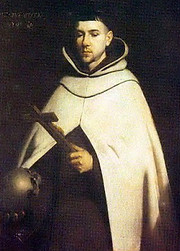
St John of the Cross, Spanish friar, mystic and poet, 1542-1591.
Week 3 Practice Journal
Click the icons to access or download the practice journal in PDF and Word formats.
The PDF version should download on any system. Print it off then write on it by hand. The Word version can be typed into using MS Word or something similar. (After opening the Word version you may have to 'enable editing' before you can type into the documety.)
